Guide · Updated November 2026
How to transcribe guitar solos and riffs
Working out a guitar part from a record is one of the best ways to grow as a player. These steps take you from a fast, buried solo to something you can play with the band, whether you learn by ear or check your work against tabs.
A step by step workflow
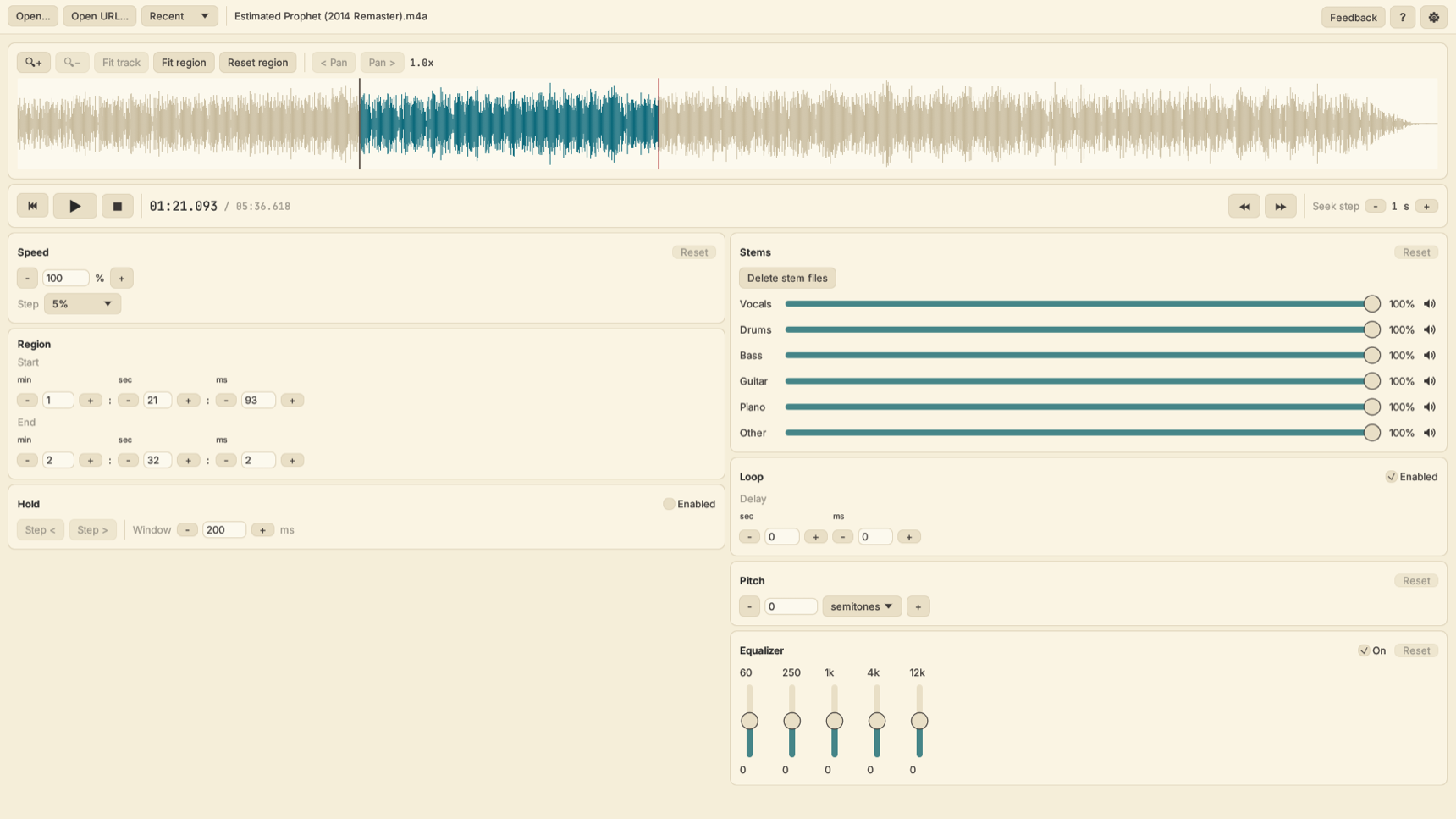
- Isolate the guitar. Separate the song and mute everything except guitar. Now you hear the guitar without vocals, cymbals, and keys on top of it. If you lose your place in the song, bring the drums back in quietly.
- Loop one phrase. Drag on the waveform to mark a single phrase, usually one or two bars. Zoom in on the waveform to set the start and end exactly on the notes.
- Slow it down. Drop the speed to 50% or lower. The pitch stays the same, so every note is still the note you will play. Fast legato runs and sweep picking often need 30% to 40%.
- Find the first note, then the next. Sing the note, find it on the neck, and move on. For a tricky spot, use hold mode to replay a tiny window of the phrase over and over until you hear it.
- Build up to speed. Once you can play the phrase slowly, raise the speed in small steps. Pick a step size of 1, 2, 5, 10, or 25 percent and nudge it up each time it feels clean, until you are playing along at 100%.
- Play it with the band. Mute the guitar and play the part yourself with the original recording.
Tips for guitar parts
- Down tuned records. Many players tune down a half step or more. If the song sounds slightly off from your guitar, shift the pitch in semitones until it lines up, or tune your guitar to the record. For records that sit between notes, adjust in cents.
- Bends and vibrato. Slowing a bend down makes it easier to hear where it starts and lands. Listen for whether it goes up a half step, a whole step, or more.
- Two guitars. The guitar track can contain both rhythm and lead parts. Use the EQ to favor one: lead parts often sit higher, so cutting 250 Hz and boosting 4 kHz can bring a solo forward.
- Hear the chords under a solo. Bring the bass back in. The bass note usually tells you the root of the chord, which tells you what scale the soloist is drawing from.
- Check against tabs. If you have a tab or sheet music, use the loop to check each phrase against it. Published tabs are often wrong, and your ears will tell you where.
Also learning other parts of the song? See the guides for bass, drums, and piano.
Questions
What is the best software for learning guitar solos by ear?
Look for software that can isolate the guitar, loop a short phrase, and slow it down without changing the pitch. SlowItDown does all three in one desktop app for Mac, Windows, and Linux, for $19.95 once.
How slow should I play a guitar solo to transcribe it?
Start around 50% speed and go lower for fast runs, often 30% to 40%. Because the pitch does not change, you can slow down as much as you need and still hear the right notes.
Can I remove the guitar and play along?
Yes. After separating the song, mute the guitar track and play the part yourself with the original band.
Try SlowItDown free for 7 days
Isolate instruments, loop any section, and slow it down, all in one desktop app for Mac, Windows, and Linux. $19.95 once or $1.99 a month after the trial.